Wednesday, February 12, 2014

Wednesday with Words: On Our Identity in Christ

Yes, another quotation from Carolyn Weber's Surprised by Oxford.  But this is my last for now. J  If you want more, I suggest you just go read the book.
 
This from a discussion with her mentor, Regina, who had also juggled marriage (and widowhood), family, and being a Christian in acadamia:
 
"'Carolyn,' she began earnestly, 'all of these 'things' mean nothing in and of themselves.  They are just objects, just means to an end.  What does it matter what committee you serve on?  What promotion you get?  That book you labor over to write and publish, someone will end up resting a coffee cup on, without any care as to your sacrifice.  Your children are only young once.  Your marriage provides you a chance to put someone else first daily.  Such things refine your soul."  A fond, faraway look passed over her eyes, and I caught myself remembering that she was a widow… What is important is that my identity doesn't lie primarily in being a professor, or being a wife, or even in being a mother.  Those things will always fall short.  Entire careers get swept away at a moment's notice at the presentation of a pink slip, a vote of the elders, an accusation of a student, a cut in the budget.  Marriages face infidelities, for instance, and end up like car wrecks from which people can recover but are never again the same.  Children grow up and move far away and forget to write or call – as they should.'  She smiled wistfully.  'The point is, if you have your identity in any of these things, it's surefire disappointment.  Anything man-made – or woman made, for that matter – will and does fail you.  Having my identity in Christ first and foremost gives me the courage – yes, the courage – to live my life boldly, purposefully, in everything I do, no matter what that is."
 
                ~Carolyn Weber, Surprised by Oxford
 
http://www.ordo-amoris.com/2014/02/wednesdays-with-words-week-29.html?utm_source=feedburner&utm_medium=feed&utm_campaign=Feed%3A+blogspot%2FOrdoAmoris+%28Ordo+Amoris%29
Click through for more inspiring quotes!
 

Tuesday, February 11, 2014

Desiring the Kingdom Book Club: On Realigning Vision and Practices

Our reading assignment this week was the first portion of Chapter 3.   Quite honestly, I don’t really have a whole lot to say about this section. Basically, he is talking about cultural exegesis - examining the liturgies (practices) of our culture at large so as to discern whether they are pulling us towards our vision of the good life or away from it. While I think this is a good practice to have, my thoughts have been veering far more towards my own personal practices and those of my family, so that's what I want to talk about today.
 
Early on in our book club, I realized that I really didn’t have a clear sense of vision – what is my vision of “the good life”?  Towards what is my heart aiming?  I know very well what it should be, what I want it to be.   The good life is the life lived for the glory of God, the life that chooses to “be content in all situations” and that embraces the good along with the bad with the recognition that it all leads to my sanctification and His greater glory.  But if I'm  honest, somewhere along the way my vision has sort of slipped.  If I’m honest, the first thing that comes to my mind when I think “the good life” now is that the good life is peaceful, quiet, and comfortable with no one to bother me or ruffle my feathers. (I could very easily be a hobbit living out my days in a peaceful hobbit-hole!)  It is a selfish vision of life centered on my own personal comfort.  
 
Ouch.
 
I’ve been thinking about where along the way my vision shifted, and why.  There are a variety of reasons that I can think of: being raised with a rules-based idea of Christianity, little sins that I've let go untended, and plain ol' weariness (physical, emotional, and spiritual) all figure in. 
 
Now, this all has me thinking about where I ought to adjust our practices to help my heart realign with the vision.   Some of those are bigger picture things – like considering how to plan our next furlough to allow for true rest and combat that sense of weariness.  Some of those are smaller picture things that I can put into practice now.  As a matter of fact, just this past week we revamped our evening routine.  This was partly inspired by Mystie's post last week -  just as she shared that she is often tempted to retreat into the computer and hide from her children in the morning, I admit that I am tempted to do this to escape the chaos of our house in the evening.  It occurred to me that this 'practice' of mine is connected to that vision of the good life being centered on my own personal comfort rather than a willingness to embrace the messiness of our family life.  It also sent the message that we just wanted the children to go away and get in bed already and that family devotional time was just something tacked on to the end of the day - an obligation to get through because we should rather than a time focused on growing in our sense of wonder, awe, and admiration of the God we serve.

So now, rather than letting chaos reign as it did previously, we are trying something like this:

Kids clean up, shower, and help set the table while I make dinner (occasionally one of them will come cook with me.)

We eat, with the goal of it being not later than 6:30pm. 

After dinner, I go clean up the kitchen.  (My husband, bless him, has done this for the past 10 years of our marriage, but I realized that if I was serious about breaking my bad habit of hiding by getting on the computer, I needed to replace it with something else tangible to do during this time.)   Dan and the kids will spend this time doing something special together - sometimes a game, sometimes an episode of a television program, sometimes some other silly project like folding paper airplanes.  This is assuming that everything got cleaned up and everyone showered before dinner...this is their motivation if you will.  If you still need to take a shower or pick up your room, then you miss out! :)

When kitchen clean up is done, we join back together again for our evening Bible story and read-aloud time before sending little ones off to bed by 8 or so (the oldest is allowed to sit up in her room quietly reading or drawing for a little longer).

It remains to be seen how this will all play out in the long run, but I do have great hope that we are headed in the right direction with this plan.  I kind of see it as a framework not only to take care of the chaos-problem, but to cultivate habits of selflessness, serving one another, enjoying one another, and growing in grace together as a family.
 
http://www.simplyconvivial.com/2014/desiring-the-kingdom-book-club-week-6-liturgies-of-consumerism
Click through for more thoughts and insights on this section!

Monday, February 10, 2014

What We've Learned: January 2014

Education is an Atmosphere
“God saved you to sanctify you.  God is in the beautification business, washing away spots and smoothing out wrinkles.”
~Kevin deYoung, The Hole in our Holiness
 
Family life is truly a crucible for sanctification.  It is here that I am made most aware of my wrinkles, and most aware of my need to depend on Him.
 
 
Education is a Discipline
We’ve been back to school for about 4 weeks after 2 weeks of co-op in December and 2 weeks of Christmas Break.  It’s taken us about that long to get back into anything resembling a normal routine – in actuality we’re still trying to get there.  This week probably won’t be the week….but maybe next?  One can hope, right?
 
That said I’ve been thinking a lot about habits and routines lately.  Some of this inspired by this blog post, and some by our discussion of Desiring the Kingdom.   Perhaps my goal should be to take some time over the next month to think through what our goals should be. J
 
 
Education is a Life
Reading to Keep Cool


 Michelle (Age 8 – Grade 2 – Ambleside Online Year 2)
After Christmas, we truncated the last 6 weeks of Year 1 into 3, which worked out fine because the reading schedule was pretty light.  We did exams again, and I was pleased with the results.  The favorite book of the term turned out to be Viking Tales.  (Even I was rather fascinated to realize that it was the Vikings from Norway that settled Normandy, and from there went on to conquer England.)  Here are her exam questions and answers relating to that book:
Tell the story of Gyda’s saucy message and what Harald had to do before she would become his wife. (Viking Tales)
His uncle went to Gyda with a lot of men, but she said she would not marry Harald until he was King of all Norway.  So he had to fight and fight until there was no one else to fight with.
 
Why was Harald known first as Harald Shockhead and then as Harald   Hairfair? (Viking Tales)
Gyda sent a saucy message and Harald said he would not cut his hair or even comb it until he was king of all Norway.  So as he had not cut or combed it, his hair stuck out on every side of his head.  After he had fought for a long time, he said he was king of all Norway so he washed his hair and combed it and the Earl cut his hair.  And then they said he wasn’t going to be called Harald Shockhead anymore, but be called Harald Hairfair.
 
We have since started Year 2, this time pretty much completely as written with the exception of the fact that we are using Little Pilgrim’s Progress instead of the real thing (we’re saving that for next year) and we switched the order of Seabird and Tree in the Trail because Seabird we already had, and Tree is still on the Slow Boat. J   I have assigned Michelle to read Leif the Lucky, The Burgess Animal Book, and Understood Betsy independently this term, so we’ll see how that goes.  Her narrations from this first week were quite good.   I am really excited about this Year – so many wonderful books in there!
 
In Math U See Beta, we’ve completed through Lesson 19 and will start multi-digit subtraction next week.  The past couple weeks we have been doing big column addition problems with numbers in the hundreds and thousands and have learned some good lessons in being careful with our work and finding ways to make 10’s, a very helpful strategy when adding big columns with 4 or 5 numbers.  We have also been playing around with money – both American currency using RightStart games and Cameroonian currency via keeping track of her allowance.
 
Michelle continues to enjoy playing around with words – we’ve been doing little bits of spelling and grammar and she seems to really enjoy both of these things (she actually asks if/when we are going to do them!)  Nature study is one of those things that’s gotten left off in the quest of getting back into a routine, but they have enjoyed informally observing our pet mice!  Some of my goals for her for this coming term are including more map work with our history and geography readings and upping the amount of writing that she is doing a little bit.  (Yes, she is a bit on the young side by CM standards, but she is more than ready and capable which I think is a more important rule of thumb than an arbitrary age.)
 
Reading by headlamp

 
James (Age 5-1/2 – Advanced Pre-K – Year .5)
I just shared about James’ Year .5 plan here.   We are really enjoying our time together each day. 
 
Reading is more fun with a friend

 
Elizabeth (Age 3-1/2 – Along for the Ride – Ambleside Online Year 0)
Elizabeth often sits in on James’ Year .5 readings…or else she goes outside to play.  We are blessed to have lots of little preschoolers running around our compound these days. J  She loves doing poetry with us though, and always wants a turn to recite.  We occasionally do a page from a Rod and Staff preschool workbook, and I’m thinking about getting some alphabet manipulatives out for her to play around with sometime soon.   She definitely has a fascination with the letter “A” (the first letter of her real name) and the number 3!  Those are hers.  She is also always asking “why?”, and sometimes her questions completely stump me.  (“Why is that a carrot, mama?  Why is grandma your mom, mama?”)
 
Shoot, even the pets read at our house...

 
Mama (Age ?? – Always Learning – Ambleside Online Year 4)
I just finished reading through Term 1 of Year 4.  My surprise favorite has been Robinson Crusoe.  I never in a hundred years would have picked up this book to read on my own – guy stranded for almost 30 years on a deserted island?  No thanks! – but I am so glad that AO included it in the curriculum.  This book is packed full of insights about God’s care, God’s sovereignty, gratitude, and far more.  I’m looking forward to reading and discussing this one with my kids when they get to that point.  Next week, I’ll start Term 2, and am adding Plutarch to my reading list this time around.
 
Aside from my AO reading, I have also been enjoying The Iliad with the Forum book discussion group – not only is it an exciting, epic adventure, it is also an interesting observation of human nature.   And several of us have noted that reading about the capricious nature of the Greek gods makes us more grateful for our True God who is Good, Sovereign over all things, and Unchanging.
 
What have you been learning?

Friday, February 7, 2014

James' Year 0.5 (Kindergarten) Plans

James is 5 and a half years old.  Technically, he could have started Kindergarten this past fall, but for a variety of reasons we decided to wait on officially enrolling him with our co-op/umbrella school as a Kindergartener until this coming fall, when he will be 6.  I hadn't really planned on doing any formal kindergarten work with him until then.  We've done a bit of work informally on and off over the past couple of years, but it hasn't ever been consistent aside from him joining us for Tea Time.
 
 
But then, he taught himself how to write all his letters (using a dry-erase tracing book).  He took the little bit of phonics and word-building work I had done with him and ran with it, and the next thing I knew he was reading Dr Seuss, and then just about anything he could get his hands on.  And  then he started inserting his own comments and opinions on the school books I was reading with Michelle. 
 
It was time to kick it up a notch.
 
Ambleside Online doesn't offer an official kindergarten year, and Year 1 isn't meant to be started with a child younger than 6 years old.  Those who need or want something for a kindergarten child usually end up cobbling together what is sometimes referred to as 'Year 0.5' – a transition between the informal preschool (Year 0) years and officially beginning Year 1.  Here are the resources that we are using for our Year 0.5:
 
Reading: He reads aloud to me daily  from the Treadwell Reading Literature readers or other appropriate-level books, such as the Little Bear series.   As needed, we do a bit of word-building or word-visualization using letter tiles at the white-board.
Handwriting: He copies 1 short sentence from his reader, directly underneath a model.
Math: We are using MEP Year 1 very, very slowly, spending 2-3 days on each lesson, with heavy emphasis on the hands-on activities in the lesson plans.
 
Read-Aloud List:
Poetry (Daily): Mother Goose rhymes, Lavendar's Blue, Eric Carle's Animals, Animals
AND one of the following:
Literature: The Wonder Clock (Pyle)
History: Fifty Famous People (Baldwin)
Natural History: Among the Farmyard People (Pierson)
Geography: Highroads to Geography (Anonymous)
 
I am not yet asking for narrations from these readings, although sometimes we will talk about what he liked or didn't like about a story.  Sometimes he offers a narration on his own.  But we will wait until after his 6th birthday in June to really begin narration in earnest.
 
Notes: Total Time for all of this is 30-40 minutes per day, aiming for 4x per week.  He also joins us for Tea Time which is another 30 minutes or so, and often for Drawing and Nature Journaling on the days we do those.   Also, keep in mind that this is my plan for James, meeting him where he was at.  Most students don't start kindergarten already having taught themselves how to read and write. J   Typically, kindergarten students will just be beginning reading and handwriting instruction.  See this very helpful blog series for hints on how to approach these subjects Charlotte Mason style.

Wednesday, February 5, 2014

Wednesday with Words: On why we Ought to Memorize

Once again quoting from Carolyn Weber's wonderful memoir, Surprised by Oxford.  This quote came from a discussion in one of her Oxford literature classes after a student asked the professor why they had to do memory work.
 
"Consider how easy you have it,' he replied.  "Many of the Romantics knew much of Milton by heart – how can you study these writers if you do not know what was in their hearts as they themselves wrote?'  Then he added, thoughtfully, 'While you are at it, I also suggest that you memorize the first few chapters of Genesis.  So you know what was in Milton's heart too.'
 
'Why memorize it?  Why not just read it carefully?' argued Susan, our Yale 
graduate.
 
'Because what you memorize by heart, you take to heart,' replied Dr Nuttham simply.  "It shouldn't be called by 'rote' but by 'root', for you get at the source of the text, its foundation.  Once you really absorb the words, the words become you own.  Then, and only then, can you mull them over on your tongue, appreciate them as you would good wine, enjoying them as the company of a good friend.  Besides,' he added, 'we always value something for which we've had to labor."
 
                ~Carolyn Weber, Surprised by Oxford
 
http://www.ordo-amoris.com/2014/02/wednesday-with-words-week-28.html?utm_source=feedburner&utm_medium=feed&utm_campaign=Feed%3A+blogspot%2FOrdoAmoris+%28Ordo+Amoris%29

Tuesday, February 4, 2014

Desiring the Kingdom Book Club - Chapter 2,"Love Takes Practice"

Summary
Smith starts the chapter by reminding us that human beings “can’t not be lovers, we can’t not be desiring some kingdom. The question is not whether we love but what we love.”   He uses an example of our consumer-culture to illustrate: in a sense, marketing companies have gotten something right because they have tapped into our loves, our desires.  The response of the church (of Christian education and discipleship) should be to redirect those desires rather than to redirect thoughts.   
 
Smith proposes that the way to redirect our loves/desires is through practices: “routines and rituals that inscribe particular ongoing habits into our character, such that they become second nature to us.”  He cites research that has found that these habits, these practices, become ‘automatic’ over time.  This is equally true of habits we seek to form intentionally (such as practicing the piano) and those that are formed unintentionally by the practices that we are naturally immersed in.  (This reminded me of how Charlotte Mason says that habits  of one sort or another will be formed – it’s better to take care that they are the habits we want to be formed!)  
 
Smith differentiates between “thin” and “thick” habits – “thin” ones being things like brushing our teeth or watching the news after dinner – they don’t necessarily inform our identity and core values.   “Thick” habits “say something about us (our identity) and continue to shape us into that kind of person” – anything that is “meaningful and identity significant”.   It isn’t always cut-and-dried, sometimes the line can be fuzzy.  I still really appreciated the fact that he drew a distinction here, however.    Sometimes I feel like some of the “CM style habit training resources” out there try to lump “thin” habits like cleanliness into the same category as “thick”, moral habits such as obedience, one reason that sometimes discussions about habit training make me get all squirmy.  I happen to view them as two different things and feel that they need to be approached in different ways, so I appreciated Smith acknowledging a difference here too. 
 
(I’ve written before on my take on CM-style habit training here and here – as I went back to re-read those posts, I realized that a lot of that applies to what Smith is trying to say in this chapter as well.)
 
 
Thoughts
In this chapter, there is a section in which Smith encourages us to do a “practices audit”.  He provides us with a number of questions to help us evaluate our practices – what they are, and what we feel that they should be, if they are having the effect that we want them to have or not.  This is a fantastic idea which I unfortunately have not had the time or mental energy to tackle yet, but I hope to soon. ;)
 
That said, I have been thinking a lot over the past several weeks about my vision, the vision I want to present to my children, and if our practices align with this vision.   I have some thoughts percolating on this that I had intended to share here, but find myself not quite able to articulate them yet.  So, stay tuned. J 
 
http://www.simplyconvivial.com/2014/desiring-the-kingdom-week-5-thick-thin-practices#.UvDebWeA3Gg
Click through to read more thoughts on this section!
 

Saturday, February 1, 2014

Winter Term 2014 Morning Tea Time Plans

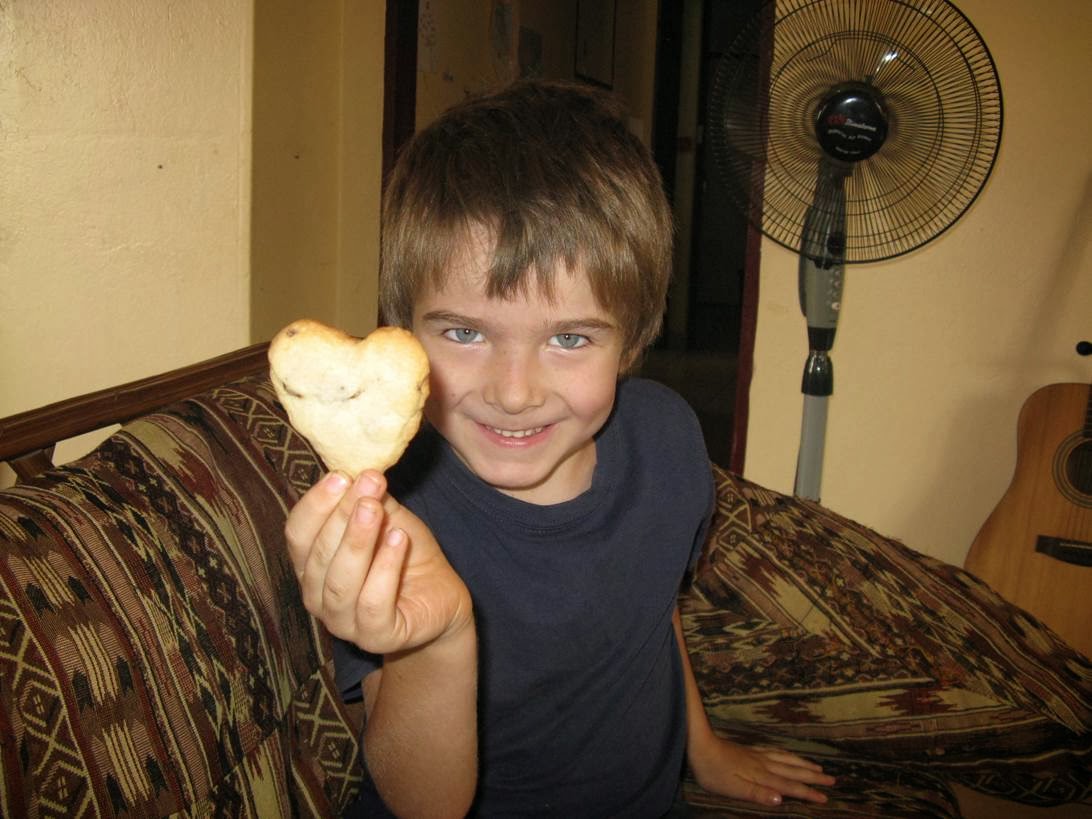
Our sweet friend Carolyn (my "tea friend") made us the heart shaped cookies special for our tea-time one day last week. :) 
 
So…perhaps it is sort of a joke to call it 'winter term', since we are in our hot-dry season here….but we are still technically north of the equator, and 'winter term' sounds better to me than 'hot and dry season term', so there you go.  (Maybe it's a little bit of wishful thinking?  Although I don't think I'd really dig all that sub-zero stuff going on in the Midwest…OK, now I'm just digressing….)
 
You can see some of our inspiration and rationale for our morning tea-time here.  Many people include Bible/hymns/Scripture memory as part of their group time as well, but we do those as a whole family devotional time and the beginning and end of the day.  But I have included what we are using for those subjects here anyhow.  That all said, here are the plans that I have drawn up for this term:
 
Daily Subjects:
 
Poetry Reading and Memory Work
Our poet this term (AO Year 2, Term 1) is Walter de la Mare.  We will probably also sneak in The Pied Piper of Hamelin (Browning) towards the end of the term – this is a Year 2 Free Read.
Poetry I have already selected for memory:
  • "A Child's Prayer" (M. Betham-Edwards)
  • Bottom's "Dream" Speech from A Midsummer Night's Dream, Act 4, Scene 1, Lines 214-225  (taken from the suggestions in Ken Ludwig's How to Teach Your Children Shakespeare) – this will be the third brief Shakespeare speech we have learned, and all three kids love to participate in this.
  • We will also be keeping our ears peeled for a poem or two of de la Mare's that we particularly like to memorize later in the term.
 
French or Folk Song
French songs are TBD – I'm waiting on a new resource for this that I ordered and have coming on the Slow Boat. J I'd also like to add some of the French songs that are sung at our church, but need to remember to ask if I can borrow one of the songbooks we use for a week or two.
 
Folk Songs – we are roughly following the AO rotation, but I think are about a term or so off schedule.  This term we are doing The Battle of Otterburn, Wade in the Water, and Down in the Valley.  Folk Songs have been another big, unexpected hit around here.
 
1 Weekly Subject
See Below. J
 
Weekly Subjects:
Day 1
Cultural Geography: Rainforest Adventure by Horace Banner – part of the Adventure series
AND
Composer Study: We are continuing with Beethoven for another term, since our last term got kind of interrupted with the holidays (and there's a lot of ground to cover with Beethoven anyhow).  We have been slowly reading Opal Wheeler's Beethoven biography.  (We aren't really following the AO rotations for composers, although I use their suggestions for inspiration for pieces to focus on.)
OR
Artist Study: Eduard Manet
 
Day 2
Little Pilgrim's Progress by Helen Taylor
 
Day 3
The Fairy Book by Dinah Maria Mulock
 
Day 4
Beautiful Stories from Shakespeare by Edith Nesbit
 
Family Devotional Time:
Scripture Memory:
It's entirely possible we won't get through all of these this term, but we will continue through them until we've learned them all and then I'll choose new things to work on. J
Books of the Old Testament
Matthew 5:14-16
Psalm 63
2 Timothy 3:16-17
John 14:6
 
Catechism for Young Children:
We are currently on Question 66, and typically get through 10-15 questions in a term, depending on the length and complexity of the answers.
 
Hymns:
We've been learning hymns since Michelle (now 8) was only 4, so we have quite a few under our belts.  Rather than choose any new hymns this term, we are going to spend this term cycling back through all the hymns we've already learned, one each week.
 
Scripture Reading:
In the morning, we read a portion of Psalms and Proverbs.
In the evening, we are reading from Catherine Vos' A Child's Story Bible.
 
Sunday Reading Choices:
God's Promises and God's Providence (Michael)
John Calvin and/or John Owen (Carr)
Gladys Aylward: The Adventure of a Lifetime (Benge)
Amy Carmichael: The Hidden Jewel (Jackson)
Pilipinto's Happiness (Shepard)